
Caucus for RCV
Support Pro-RCV Candidates & Make RCV a Priority for Your Party
It’s time to caucus for RCV! Caucuses are an annual chance to gather with our neighbors to set the party agenda for the next year, whether you support Democrats, Republicans, or a 3rd party. You can help advance ranked choice voting in our state by helping educate caucus goers about RCV, submitting an RCV resolution, becoming a delegate to your district convention, and working to endorse pro-RCV candidates!
Note: You do NOT have to be a registered member of a party to caucus. You just have to in general agree with the party’s platform and not be a supporter of any other parties.
What:
Party caucuses: neighborhoods meetings to endorse candidates and set party platform
When:
February 3 at 7:00pm (we recommend arriving at about 6:30pm to make sure you are checked-in and ready to go at 7:00pm)
Where:
Use the Caucus Finder Tool starting January 14 to find your caucus site for the DFL and Republican parties
Ranked choice voting empowers voters to rank candidates in order of preference and ensures candidates earn majority support to win. It incentivizes positive campaigning and civility, reduces political divisions, promotes more inclusive and representative elections, and eliminates the spoiler problem once and for all.

HIGHER TURNOUT
All five RCV cities had historic turnout in recent election cycles compared to comparable elections.
POPULAR
76% of MINNEAPOLIS VOTERS have said they wanted to keep using RCV, and 69% said they wanted to use it in statewide elections.
DIVERSE WINNERS
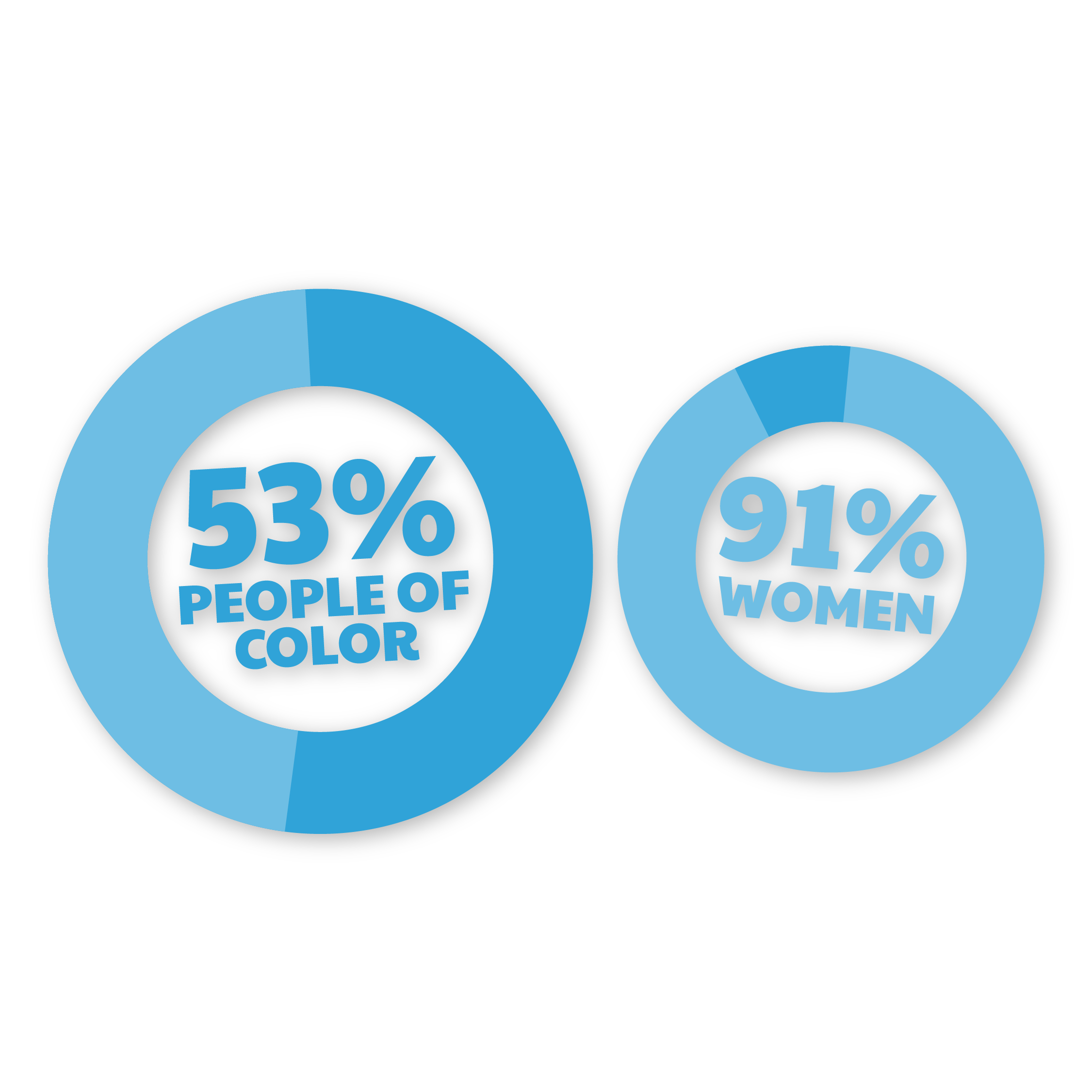
Of the 34 candidates elected using RCV in 2023, 31 were women (including all-female city councils in Saint Paul and Minnetonka) and 18 were people of color.
Caucus Details
Caucuses are the first step in helping to elect pro-RCV candidates. This year, all state House representatives are up for election, and we need to continue to work for a pro-RCV majority.
DFL caucuses:
If you’re caucusing with the DFL, you can find information about the caucus process HERE.
Republican caucuses:
If you’re caucusing with the Republican Party,you can find information about the caucus process HERE.
Minor party caucuses:
If you are a member of an independent or other minor party, contact them directly about their caucus process. You can find contact information on the Secretary of State’s website.
At caucuses, you’ll be able to:
Submit a resolution in favor of ranked choice voting.
While the DFL has RCV as part of its ongoing party platform, we want to ensure the RCV local option, allowing all localities the ability to adopt RCV, is included as a DFL Action Agenda item. You can download a draft resolution HERE. If you’re caucusing with the GOP or another party that does not have RCV in its party platform, you can download that draft resolution HERE.
Sign up to become a delegate to your senate district convention this spring.
From there, you can vie to become a delegate to the state convention in June. This is a very important step. We need RCV advocates to continue all the way through the process and make RCV a priority issue this election session!
Find out the position of your state house district candidates on ranked choice voting.
You can meet them and let them know that RCV is an important issue for you.
Support pro-RCV candidates in the endorsement process.
Your Caucus Cheat Sheet
(Almost) everything you need to know to have a successful caucus
What is a Caucus?
A caucus is a gathering of neighbors who affiliate with the same political party, and a precinct is the smallest organizing unit we use for our elections—sometimes as small as just a few blocks. There are many precincts across the state, and each follows a similar procedure to do three things:
1. Propose and vote on resolutions.
Resolutions are the building blocks of a party’s platform, or statement of beliefs, and its agenda, or what it wants to get done if elected.
2. Elect delegates to conventions.
Conventions are the next step up from caucuses where candidate endorsements happen and the party platform comes together.
3. Elect local precinct leaders and committee members.
These leaders have various roles, which could include representing your neighborhood to larger party units, serving on convention committees, and helping to organize the next caucus.
The Convention Process
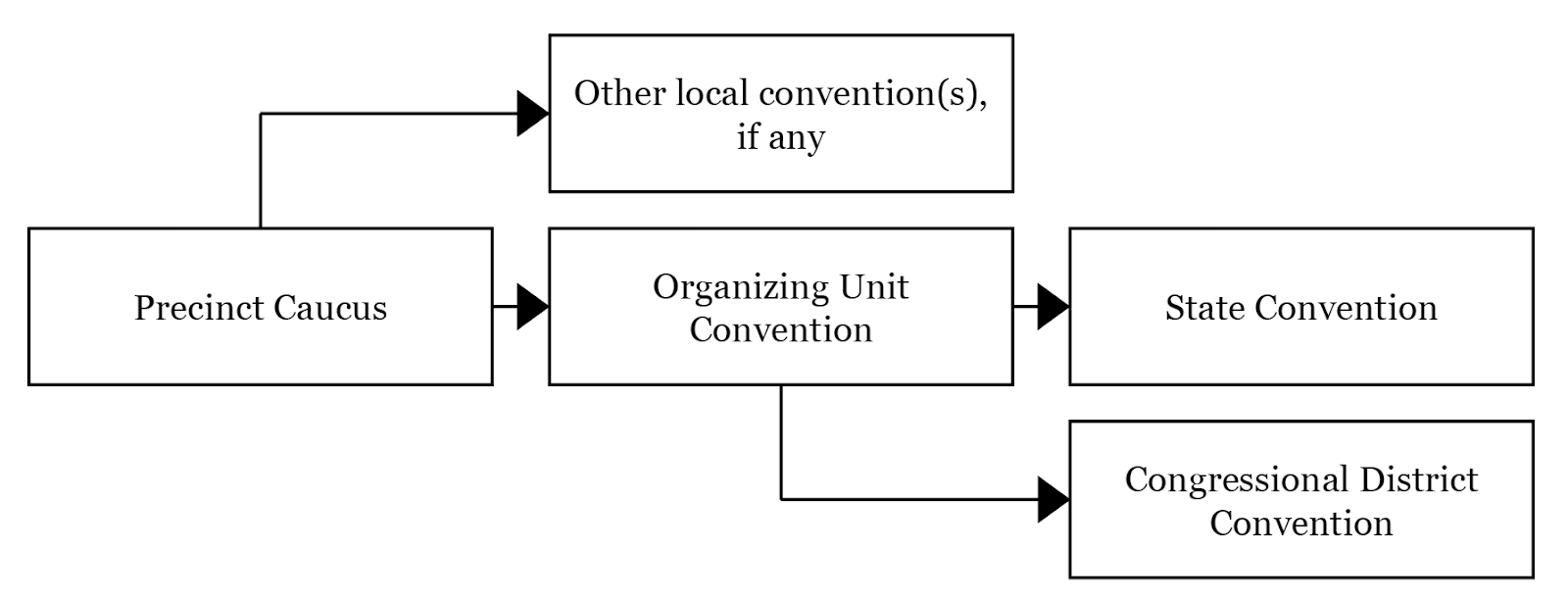
Conventions are a gathering of delegates elected from a number of different precinct caucuses—or delegates elected from a group of smaller conventions. There are a few different types, including “organizing unit” conventions, county conventions, senate district conventions, congressional district conventions, and the state convention. Often, these are combined. If you live in Minneapolis or another heavily populated area, your Organizing Unit Convention is also your State Senate District Convention, and you have a separate Hennepin County Convention to nominate candidates for county attorney, county sheriff, etc.
Becoming a delegate
Delegate spots can be very easy or somewhat difficult to get depending on where you live. Each caucus (and organizing unit convention) has a set number of delegates they are able to pass on to the next level. If fewer people volunteer to go than there are spots, you are in. If more than the number of available spots volunteer, there are a few ways to narrow the field. The caucus at large either can vote on who goes, or they can hold a “walking subcaucus.”
Walking subcaucuses
During a walking subcaucus, people divide themselves into smaller groups, often based on the issues they prioritize and the candidates they support. For example, in a past DFL caucus you might have seen a “Tim Walz” caucus, an “Erin Murphy” caucus, and an “Erin Murphy/Environmentalism” caucus. Once these groups form, the available delegate slots are divided up proportionally between them. The subcaucuses then select the delegates from among themselves. Sometimes, similar groups can join together to get more delegate slots, as the two “Erin Murphy” caucuses above likely would.
Tips and tricks:
1. Raise your hand when they ask for delegates and keep it up.
2. Being enthusiastic and not backing down if more people volunteer than there are spots.
3. Being prepared to speak for 15-20s if someone asks why you want to be a delegate.
Emphasize your enthusiasm for making RCV/reform a priority and for any preferred candidates.
Our resolutions
At every caucus, the caucus convener (meeting leader) will ask if anyone has resolutions. This is your time to shine! You will submit your printed resolution to them, read it aloud, or both depending on the preference of the convener. For the DFL party, we have a resolution to keep the RCV Local Option bill—which would allow all cities, counties, and school districts to adopt RCV if they want to—on the DFL’s action agenda. For the Republican party, we have a resolution to add it to the party platform. You can download the resolutions at fairvotemn.org/caucus.
If you live in Hopkins, you also have the opportunity to introduce a resolution in support of RCV use in your city. Send us an email to learn more.